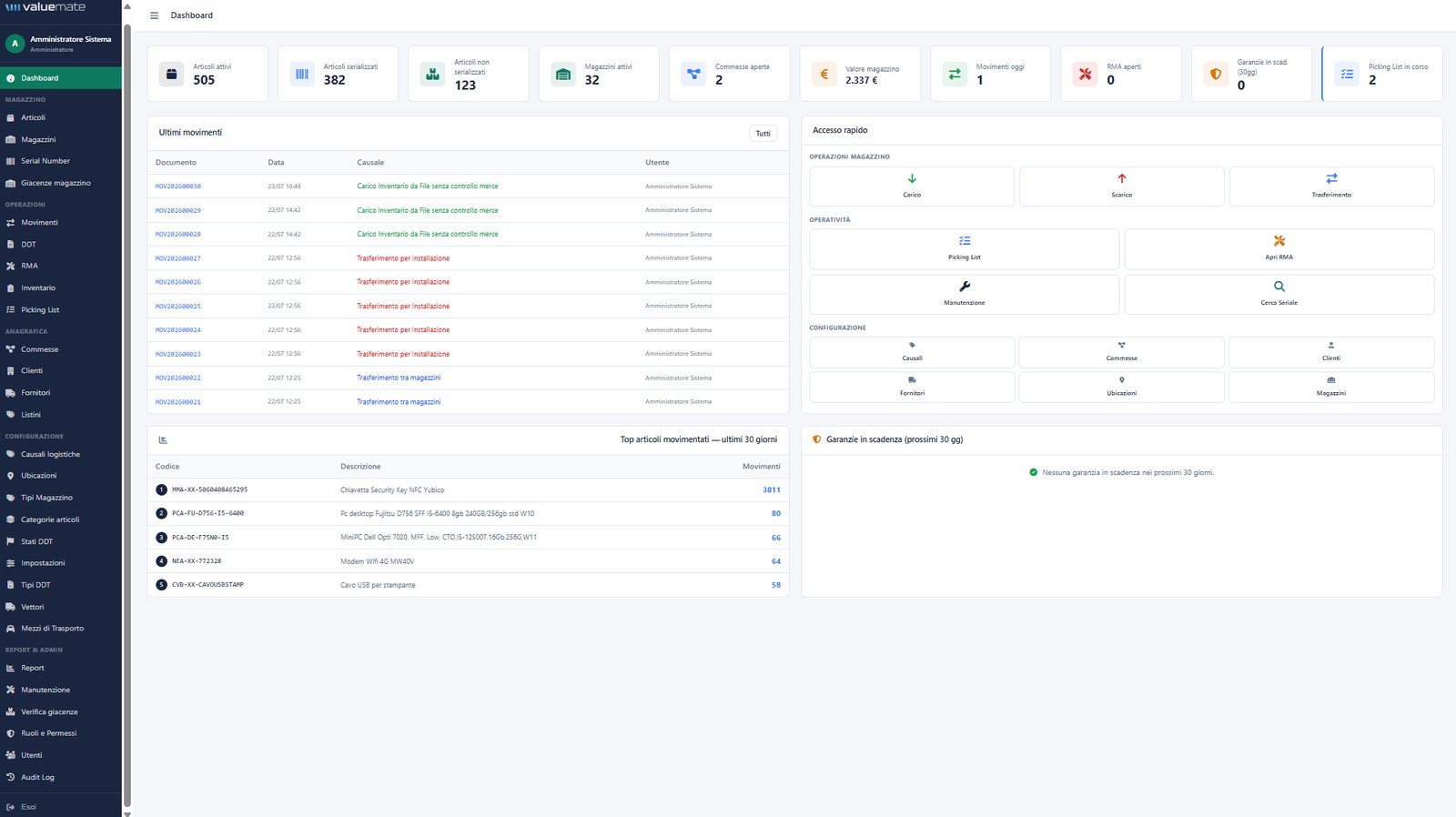
StockWave provides a single point of control for stock, locations, movements, documents and projects, ensuring complete traceability of every asset across the entire logistics cycle, from receipt through to delivery.
Multi-warehouse, multi-project stock
Every item is tracked by warehouse, project and, when needed, by serial number or production lot. It can exist across several warehouses and projects at once without ever losing track of who holds availability. Free filters and tolerant search on every column; an item can also be reserved for a specific customer, built for consignment stock.
Physical locations, not just numbers
Every stock record can be placed in a precise position, organised into zone, shelf and bay, with guided search and assignment in every screen where it is needed. The physical location of every item is always known, with no uncertainty for warehouse staff.
Warehouse types built for every scenario
Central depot, peripheral site, material held by a customer or a project, a virtual "Field Technician" warehouse for stock carried around without a physical depot, a repair lab linked to RMA cases, a verification/re-check area, a WEEE disposal warehouse. Types are never a closed list: new ones are added freely as the organisation needs them.
BAD-stock and traceability-only warehouses
"BAD material" warehouses for scrap and defective items can be automatically excluded by movement reasons as origin or destination: no chance of moving good stock into a scrap depot by mistake, or the other way round. "Traceability-only" warehouses symbolically represent an external site without creating a real depot in the system, and are usable only by the movement reasons designed for that purpose.
Movement reasons, configured in detail
Every movement reason has over ten independent rules: mandatory serial numbers, availability and location checks, mandatory warehouse/project/customer, automatic DDT generation, usability from Picking List, exclusion of BAD-stock warehouses as origin or destination.
Movements, one at a time or by the thousand
A single movement or an import of thousands of rows from Excel, with the exact same row-by-row validation. Rows spanning different warehouses or projects automatically generate the correct separate movements. The item catalogue and location map can also be populated from Excel when starting a new project.
Picking List
Generated and verified against real availability, printable for staff working on the floor. Fulfilling the list automatically generates the corresponding warehouse movement, with no re-keying between what was picked and what was recorded.
Full DDTs, with carrier and vehicle
A DDT can group multiple movements, with shipment status tracked step by step and automatic closure of linked movements on delivery. Carrier and vehicle come from reusable registries; delivery address is structured and independent from the customer record, with guided search of Italian municipalities.
Price lists tailored per project
Every customer or project can have its own price list by item group, movement reason and delivery site, with threshold-based discounts. Every project carries its own cost centre and project code, and follows a lifecycle (open, suspended, closed) that also determines what can still move within it.
Returns and repairs tracked (RMA)
Every return or repair case has its own status and outcome, tracked from opening to closure: no case ever gets lost in a mailbox or a parallel spreadsheet.
Periodic physical inventory
A physical count organised by item category or warehouse zone, filled in on the floor, closed with automatic calculation of differences against the system, with a history to see which areas need attention.
Serial traceability and warranties
Every item followed by serial number along its entire path, with instant search by position and full history. Warranty length is set once per item: expiry is calculated automatically for every unit loaded, with automatic alerts 30 days before expiry.
An operational dashboard
Total warehouse value, today's and this month's movements, open projects, RMA cases still open, warranties expiring in the next 30 days, most-moved items and Picking Lists in progress: every figure is filtered according to what that specific user is authorised to view.
Permissions down to the single record
Not just who can see what, but which warehouse, which project, which customer. A role is built by composing granular permissions per module, applied consistently everywhere: lists, exports, bulk movements, reporting.
Protected access
Passwords stored with cryptographic hashing, never in plain text. Two-factor authentication by email, configurable password expiry with forced change, account lockout, an approval flow for new users, every login attempt logged in the audit trail.
A system that checks itself
A maintenance panel constantly verifies data consistency (mismatched stock, duplicate serial numbers, orphaned documents, misaligned permissions) and proposes the fix with one click, whenever the operation can be carried out safely. A second tool compares theoretical stock against recorded stock at any moment.
Every line can follow its own ticket
A movement almost always originates from a single support ticket, but when different lines of the same movement relate to different tickets, each line can carry its own reference, independent from the header, with no need to split the movement.
Reports and exports
Stock, movements by period, serial number lists: always exportable in a few clicks, ready for management review or an audit, to cross-reference with other company tools.
Native ticketing integration
Every ticket number linked to a movement or a DDT becomes a direct link to the company's ticketing system: one click to move from the warehouse to the sales or support context that generated it. The integration runs through API, ODBC and XML.
Real-time stock inside the ticketing system
Real warehouse availability is viewable directly from the company's ticketing system, integrated through API, ODBC and XML: whoever is on the phone with a customer knows instantly whether a part is available, without interrupting the call.
From ticket to shipment, no manual steps
Booking the item happens directly from the support ticket, with an automatic request landing in the warehouse team's work queue and the delivery address pre-filled on the DDT. This integration also runs through API, ODBC and XML.
A technical foundation built to last
StockWave runs on a relational SQL database engine: consistent data even with many people working at once, immediate compatibility with the reporting and BI tools a company already has, reliable backup and recovery, and an engine that scales without needing to be rethought as volumes grow.