

Try the tool
Open the Propeller Test Bench →The Propeller Test Bench compares two fixed-pitch propellers fitted to the same boat, with the same engine and the same load. Change the pitch of one of them and the whole trade-off appears at once: bollard thrust, thrust margin over the resistance hump, time to get on plane, the rpm the engine can actually pull at wide open throttle and the top speed reached.
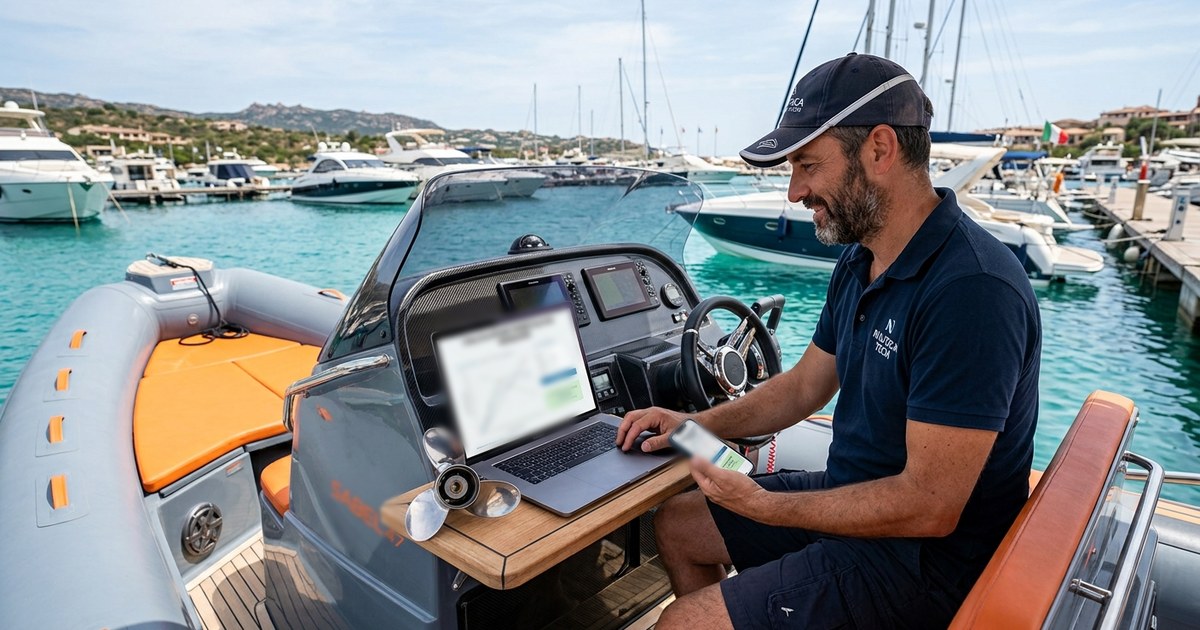
It is the question every owner faces at the dealer's counter: shorter pitch for the hole shot, or longer pitch for top end? There is never a single answer, because it depends on how heavy the boat is, how much rpm the engine can deliver and how the boat is used. Here the whole compromise is visible at once, figure by figure.
This is the ninth project published in AI-LAB: the physical model, the animated canvas drawings and the interface were generated by conversing with Claude, Anthropic's AI model.
How it was built
The project started from a natural-language description of the problem: compare two fixed-pitch propellers while holding everything else about the boat constant. Claude implemented the propulsion model, meaning thrust and torque coefficients as a function of the pitch to diameter ratio, a hull resistance curve normalised on the volumetric Froude number, the search for equilibrium between the torque demanded by the propeller and the torque delivered by the engine, and the integration of acceleration from standstill. Every drawing, from the helical wake trace to the pitch triangle and the hulls in trim, is vector artwork on native canvas, in a single standalone file with no server-side dependencies.
What the tool shows
- Side-by-side comparison of two propellers: pitch, diameter, blade count and disc area ratio set independently for propeller A and propeller B.
- Hole shot and planing: bollard thrust in kgf, thrust margin over the resistance hump, time to get on plane and the minimum rpm needed to stay there.
- Match diagnosis: the rpm reached at wide open throttle is compared with the engine rated rpm, to tell whether the propeller is over-propped, under-propped or correctly matched, together with the pitch that would bring the engine back into its useful window.
- Slip and efficiency: apparent slip, the same figure you get by comparing the tachometer with GPS speed, and propeller efficiency in every condition.
- Animated visualisations: the helical trace left in the water by the blade tip against the ideal screw, the pitch triangle, the rpm-versus-speed operating curve, the acceleration curve from standstill and the two hulls running in their respective trim.
- Automatic warnings on likely tip cavitation, excessive slip and a boat that never breaks free of the hump.
The questions it answers
How much difference does one inch of pitch make? As a rule of thumb one inch more lowers maximum rpm by roughly 150 to 200, one inch less raises it by the same amount. The tool shows the effect on both fronts at once, hole shot and top end, instead of leaving it to guesswork.
Am I over-propped or under-propped? Look at the rpm reached at wide open throttle against the engine rated rpm. Below the rated figure the pitch is too long and the engine is lugging; on the limiter without delivering full power the pitch is too short.
Do four blades improve the hole shot? At the same pitch and diameter a four-blade absorbs more torque, turns lower and gives up some top end. The advantage usually credited to it comes from the shorter pitch it is normally fitted with: here the two effects can be separated by changing one parameter at a time.
Reading the three rpm figures
Three different rpm figures appear in the panel and should not be confused. The rated rpm is an engine specification, the speed at which the manufacturer declares power. The test rpm is simply the throttle setting at which you want to photograph the boat and has no effect on the physics. The rpm reached is a result: it is where the engine actually settles at wide open throttle, when the torque demanded by the propeller matches the torque delivered. Comparing that figure with the rated rpm is the diagnosis of the match.
Model limitations
The test bench is an indicative tool, designed to make the cause and effect relationships between pitch, rpm and speed visible. The propeller is described with coefficients linearised on wide-blade systematic series, and hull resistance uses a normalised curve rather than an estimate dedicated to the specific hull. The rotational inertia of the driveline is not modelled, so planing times come out slightly optimistic. A final choice calls for the real engine power curve, the diagrams of the propeller series adopted and the judgement of a professional.
Privacy note
The tool runs entirely in the browser: no data is ever sent over the internet. Every calculation happens locally via JavaScript, with no external server calls.
AI-LAB publishes exploratory projects: this tool is not part of Valuemate's commercial service portfolio.
Want to understand what AI can do for your business?
Let's discuss how Valuemate integrates Artificial Intelligence into Service Desk, Digital Workplace and Cybersecurity services.
Talk to an expert